
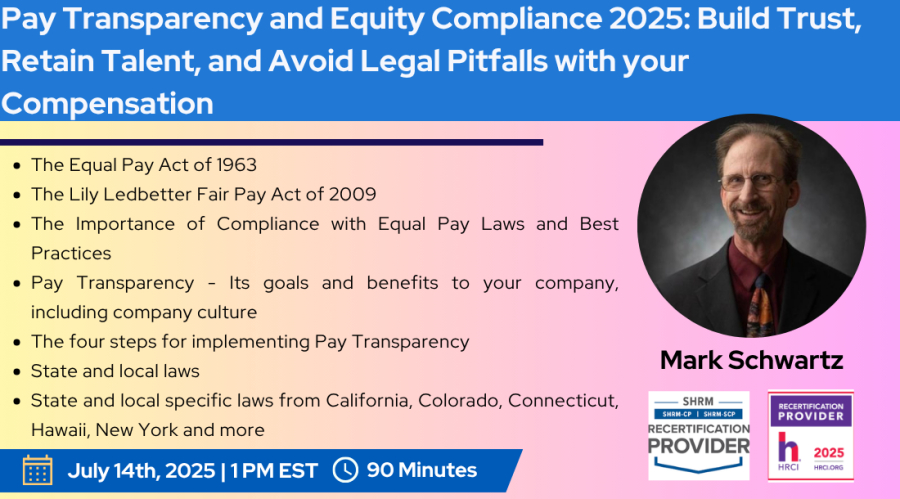




Pay Transparency and Equity Compliance 2025: Build Trust, Retain Talent, and Avoid Legal Pitfalls with your Compensation

  • shape
  • shape
  • shape
  • shape

SHRM & HRCI Approved Webinar | CEUs = 1.5 Credit Hours

Overview:

Recently, many states and local jurisdictions have enacted pay transparency laws that require employers to disclose wage information to prospective candidates and current employees. These laws aim to address pay equity and ensure that employees can discuss salaries freely, promoting fairness in the workplace.

Over the past several years, almost every state has some version of employer regulation on pay transparency. Many states enacted laws in 2025. The Federal Governments Equal Pay Act and Lily Ledbetter Act set minimum standards for pay equity. States also have their own pay equity legislation.

What will you learn:

Pay Equity:

  • The Equal Pay Act of 1963 – Demands equal pay for work based on
    • Skill
    • Effort
    • Responsibility
  • The Lily Ledbetter Fair Pay Act of 2009 - addresses when a claim of unequal pay based on sex can be filed
    • Example of claims
    • Limitations
    • Impact on Employers
  • The Importance of Compliance with Equal Pay Laws and Best Practices
  • State Equal Pay Regulations
    • General Rules for All States
    • Expanded Rules for California, New York and Maryland
    • Other states with unique rules.

Pay Transparency:

  • Its goals and benefits to your company, including company culture
    • Employee Retention
    • Stronger recruiting efforts
  • It’s possible negative effects on your employees and HR
    • Negotiations
    • Implementation Issues
    • Poaching
  • The four steps for implementing Pay Transparency
    • Conducting a pay audit
    • Delivering transparent communication
    • Fusing Pay transparency into the work culture
    • Goals and progress reports
  • State and local laws
    • General requirements under all State regulations
    • State and local specific laws from California, Colorado, Connecticut, Hawaii, New York and more...

Why you should Attend:

Pay equity is important because it helps ensure that all employees are treated fairly by eliminating wage discrimination, which helps promote diversity and inclusion in the workplace. So, ask yourself:

  • Have I kept current on my state(s) pay equity and pay transparency laws?
  • Do I understand the Equal Pay Act and Lily Ledbetter Fair Pay Act? What are their important differences? What states enacted other measures to their laws?
  • Do I understand the benefits and pitfalls to enacting pay transparency and pay equity into our business?
  • How can I enact measures to effectively implement pay equity and transparency into our business and HR culture?

Join Mark Schwartz in this informative webinar to be up to date on industry standards and compliance.

Who should Attend:

  • HR managers
  • Payroll Managers
  • Budget Personnel
  • HR Compliance Managers
  • Payroll Compliance Managers
  • Department Managers.

Mark Schwartz

Mark Schwartz

M. Swratz earned a Master’s Degree in Business Administration from Santa Clara University. He worked for 8 years as an internal auditor for private and public entities. He evaluated business operations for efficiency and effectiveness. This included regulatory compliance, financial reporting and divisions’ ability to meet and exceed goals and standards set by the organization. He evaluated CalPERS’ payroll and HR division, one of the largest such divisions in California State Government. M. Swratz has processed payrolls for approximately 1 dozen small to medium sized businesses in Sacramento. He was also a payroll tax auditor for the State of California. His most complex business included multiple shifts, overtime calculations, garnishments, wage differentials, FLSA compliance and other wage and labor issues. His payroll software is flexible to all needs of the small business community. M. Swratz has provided consultation services for 8 different national payroll webinar providers. He has a wide presence, speaking to audiences on 20 different payroll tax related topics. These include Multi-State Employment, Fringe Benefits, Audits, Root-Cause analysis, Payroll Related Fraud, and many others. This forces Philip to keep up on all the latest payroll laws and regulations in all 50 states. This ensures both accuracy in processing your payroll, but also the flexibility and knowledge to grow with your business.

Continuing Education Accreditations
Successfully completed CEU credits certification requirements.

Once you register or enroll in a live webinar course, a secure link will be provided under your profile panel. You will also receive an email invitation 24 hours prior and 1 hour before the scheduled start time containing the access link.

Yes! All courses offered by CEUTrainers are designed in tandem with professional accreditation organizations in the HR, BFSI, Payroll, and Construction sectors. Continuing Education Units (CEUs) are fully recognized and can be claimed towards professional recertifications.

Absolutely. If you are registered in a Live Webinar, the recording will automatically be made available in your account as an "On-Demand" webinar within 24 to 48 hours. On-demand courses and eTranscripts have lifetime access once acquired.

We offer a 100% satisfaction guarantee. If you are unable to attend a live webinar or find that a course does not meet your professional educational requirements, you can request a full refund or exchange credits within 14 days of purchase.

Registration Options

Live Options

$185
$325
$455
$565
$685

Super Saver Options (Get On-Demands & e-Transcripts FREE)

$815
$935

Recording & Combos

$185
$200

combo

$275
$285
$265
$375

Couldn't find the option you're looking for? Don't worry, let us know your requirements and we will get back to you SOON! Contact Us Now

Total Fee: $0.00